Every application on record. No end-of-day paperwork.
LawnPro keeps a complete record of every chemical application: the product and its EPA registration number, rate, amount, area, target pest, the applicator and their license number, and the weather when you sprayed. Crews log it while completing the visit in the LawnPro app, with the weather filled in automatically for that property. Included on every plan, including the free one.
How chemical tracking works
Set up your products once. Every application after that records itself.
Build your chemical list
Add each product from its label: EPA registration number, active ingredient, signal word, re-entry interval, default rates, and target pests.
Crews record as they work
When a technician completes a visit, the weather fills in for that property and LawnPro creates an application record for each product applied.
Share and report
Send the customer a post-application record, and export a chemical usage report for any date range when an inspector or annual report asks.
Everything you need on record
A chemical list built from the label
Set up each product once and every application uses it. LawnPro stores the product name and manufacturer, EPA registration number, active ingredient and percentage, signal word, re-entry interval, pre-harvest interval, a link to the safety data sheet, whether it's restricted-use, and the label's temperature and wind limits.
Add default rates, formulation, target pest, and site so crews don't have to look them up, and track how much of each product you have on hand.
A complete record for every application
Each application record captures the date and start and end times, the customer and property, each product with its rate, mix, and total amount, the area treated, the target pest and site, the equipment and tank size, and the applicator with their license number from their employee profile.
Technician notes and observations are saved with the record, so if a customer or inspector asks what happened on a visit, the answer is already written down.
Weather filled in for the property, at the time of the visit
When a technician completes a visit in the LawnPro app or on the web, LawnPro looks up the current temperature, wind, humidity, and conditions for that property and fills them in. The technician can adjust them, and the weather is saved on each application record.
States such as Ohio and Maryland require wind and temperature on application records, and recording weather everywhere gives you an answer if a neighbor ever asks about drift.
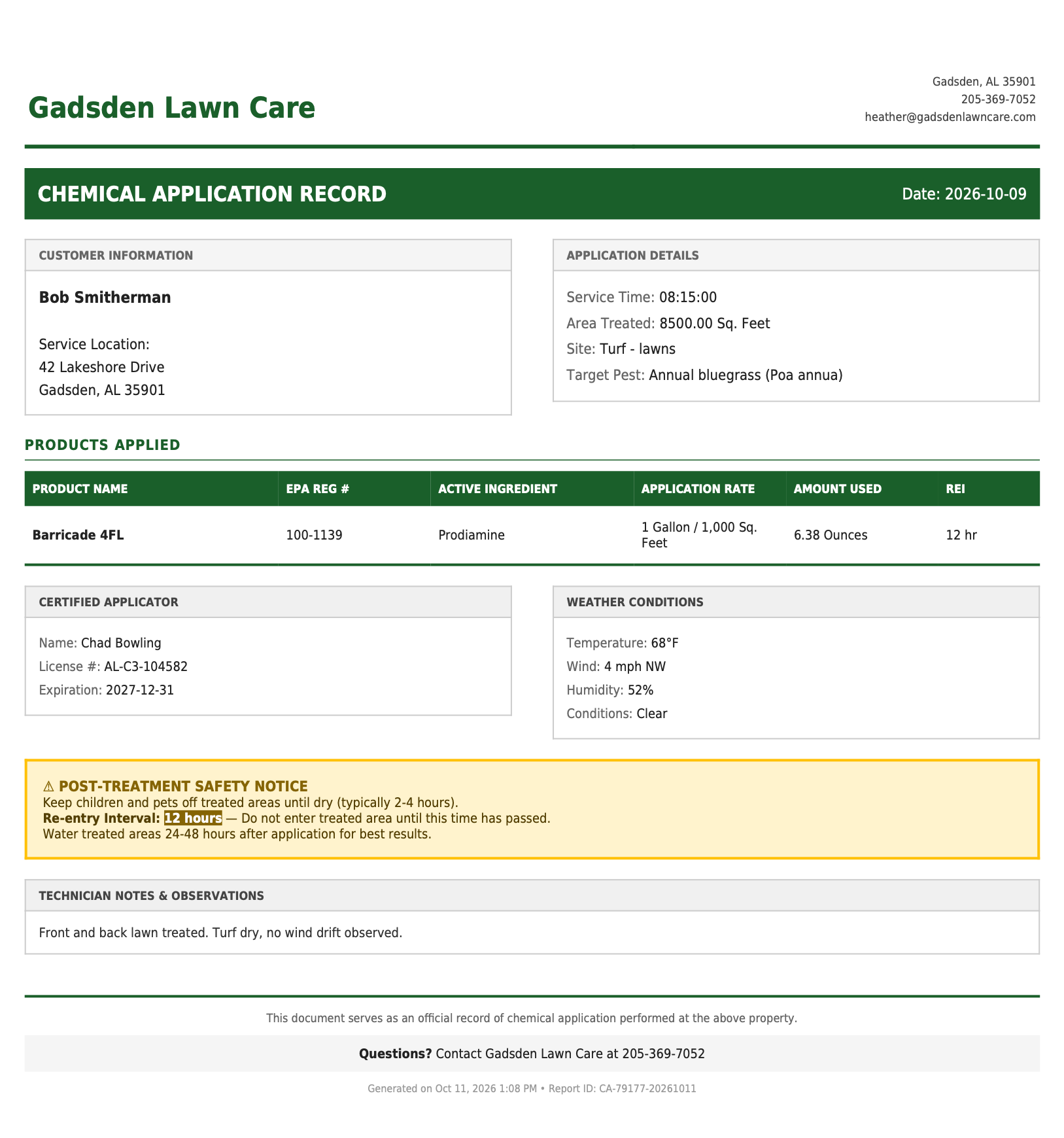
A post-application record for your customer
Email the customer a Chemical Application Record in one click. The PDF lists each product applied with its EPA registration number and active ingredient, the rate, amount, area, site, and target pest, the applicator and their license number, the weather, the re-entry interval, and a post-treatment safety notice. The email uses a template you can edit.
Or let it go out on its own: a Visit Completed automation can email or text the customer the products applied, the re-entry interval, the target pest, the technician, and the weather as soon as the visit is done.
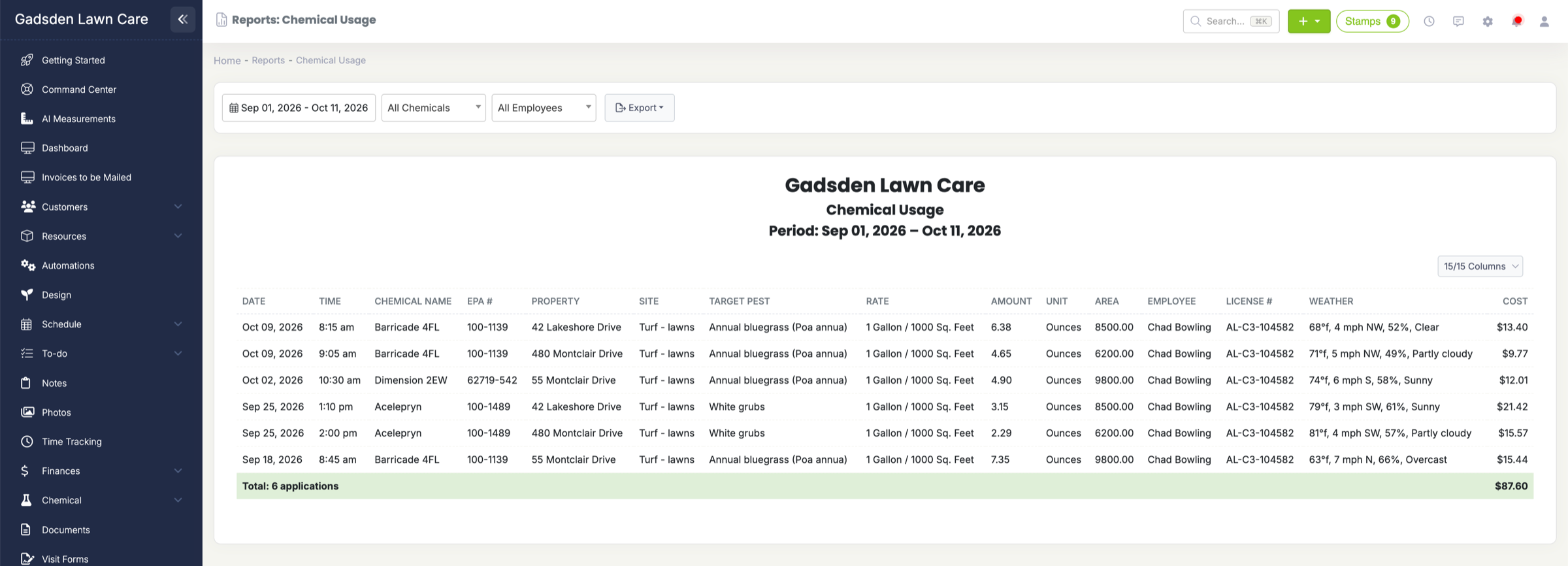
Reports for inspections and annual filing
The chemical usage report lists every application in a date range: date and time, product and EPA number, property, site, target pest, rate, amount, area, applicator and license number, weather, and cost.
Export it to CSV when your state inspector asks, or when you're preparing an annual report like New York's, due February 1.
The right product for every round, already assigned
With multi-step programs, each round of a fertilization or weed-control program has its products assigned ahead of time. Crews know exactly what to pull off the truck, and the application record is filled in from the program step when the visit is completed.
Multi-step programs are available on the Grow and Plus plans.
What states require, and where LawnPro records it
For lawn care, recordkeeping rules come from your state. The federal USDA rule for restricted-use pesticide records was repealed in July 2025, and most lawn products are general-use anyway. Many states, including Ohio, Pennsylvania, New York, Texas, Georgia, Maryland, and Michigan, require commercial applicators to record every application. Most require you to keep records for two to three years and produce them when the state asks.
| Record item | Typically required | In LawnPro |
|---|---|---|
| Applicator name and license or certification number | Nearly all states | ✓ From the employee's profile |
| Date of application | All states | ✓ |
| Time of application | Ohio, Georgia, Maryland, Michigan, Pennsylvania (some products) | ✓ Start and end time |
| Customer name and service address | All states | ✓ |
| Product name and EPA registration number | All states | ✓ Stored in your chemical list |
| Rate, dilution, and total amount applied | Nearly all states | ✓ |
| Area treated, site, and target pest | Most states | ✓ |
| Equipment used | Ohio, Maryland, Georgia | ✓ Plus tank size |
| Wind speed and direction, temperature | Ohio, Maryland (and useful everywhere for drift questions) | ✓ Plus humidity and conditions |
| Notes on spills, drift, or problems | Georgia | ✓ Technician notes |
A record isn't a lawn sign. States such as New York, Michigan, Illinois, Maryland, and Florida require posting markers at the property after a lawn application, and some keep registries of people who must be notified before you spray nearby. Keep posting and notifying as your state requires.
Rules change, so check your state department of agriculture's current requirements. LawnPro records the information; you're responsible for meeting your state's rules. Sources: Federal Register 90 FR 20083 (May 2025); EPA 40 CFR 171.303; Ohio Admin. Code 901:5-11-10; 7 Pa. Code §128.35; NY ECL §33-1205 and §33-1003; 4 Tex. Admin. Code §7.144; Fla. Admin. Code 5E-14.142; Mich. Admin. Code R 285.636.15 and R 285.637.11; COMAR 15.05.01; Ga. Comp. R. & Regs. 40-21-5; University of Illinois Extension (2026).
Frequently asked questions
In most states, yes. Many states, including Ohio, Pennsylvania, New York, Texas, Georgia, Maryland, and Michigan, require commercial applicators to record every application, and others require records at least for restricted-use products. Records are usually kept for two to three years. The federal USDA restricted-use record rule was repealed in July 2025, so your state's rules are what apply.
At minimum: the applicator's name and license number, the date, the customer and service address, the product name and EPA registration number, and the amount applied. Many states also want the rate, area, target pest, time of application, equipment, and in some states wind and temperature.
Yes. When a technician completes a visit, LawnPro fills in the current temperature, wind, humidity, and conditions for that property automatically, and each application record stores them.
Yes. Email a Chemical Application Record PDF in one click, with each product's EPA registration number, the rate and amount, the applicator and license number, the weather, the re-entry interval, and a post-treatment safety notice. A Visit Completed automation can also email or text the customer the products applied, re-entry interval, and weather as soon as the visit is done.
Turf labels usually say to keep people and pets off treated areas until sprays have dried, rather than giving a fixed number of hours like agricultural labels do. Some granular products should be watered in first. LawnPro stores each product's re-entry interval and prints it on the customer's record.
Yes. The chemical list, application records, customer records, and the chemical usage report are included on every LawnPro plan, including the free Solo plan. Multi-step programs are on the Grow and Plus plans.
Explore related features
Chemical tracking works hand-in-hand with these other LawnPro tools.
Multi-Step Programs
Run seasonal fertilization and weed-control programs with the right product assigned to every round.
Workflow Automations
Send customers the products applied, re-entry interval, and weather automatically when a visit is completed.
Scheduling
Treatment visits sit on the same calendar as the rest of your work, ready for crews to complete in the app.
Resources
Help Center
Step-by-step help for setting up chemicals, completing visits, and sending application records.
Visit the Help Center →Video Tutorials
Watch how LawnPro handles everyday lawn care work, from scheduling to completing visits.
Watch Videos →Talk to Support
Questions about chemical tracking? We're here 7am-7pm CST, 7 days a week.
Contact Us →